
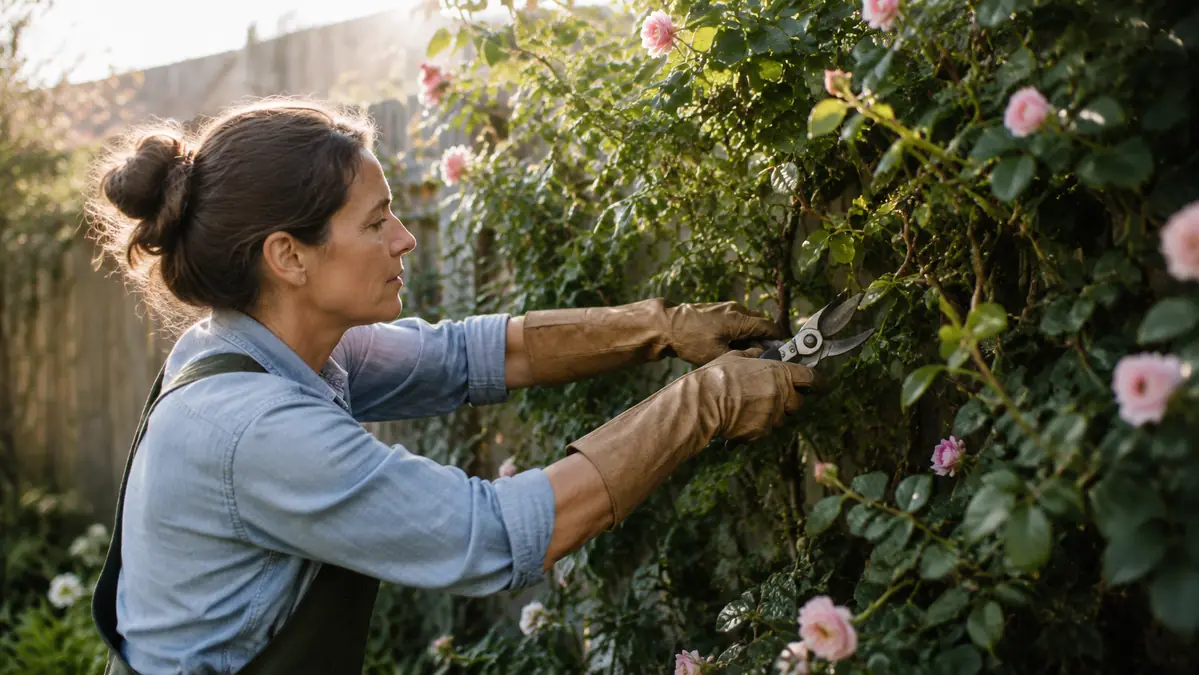
I've got fourteen rose bushes along the back fence, mostly hybrid teas with two climbers that have been walloping my forearms since the day I planted them. For three seasons running I pruned in a light pair of cloth gardening gloves and walked away every single time with thorn scratches running from my wrist most of the way up to my elbow, deep enough more than once to draw blood through a long sleeve shirt. Last spring, before the hard February cutback, I finally bought a real pair of gauntlet gloves, and I've worn the same pair through an entire year of rose care since. The two climbers in particular have canes with thorns closer to a quarter inch long by midsummer, curved back toward the stem in a way that catches skin on the way out as easily as the way in, and no cloth glove I owned ever stood a real chance against them.
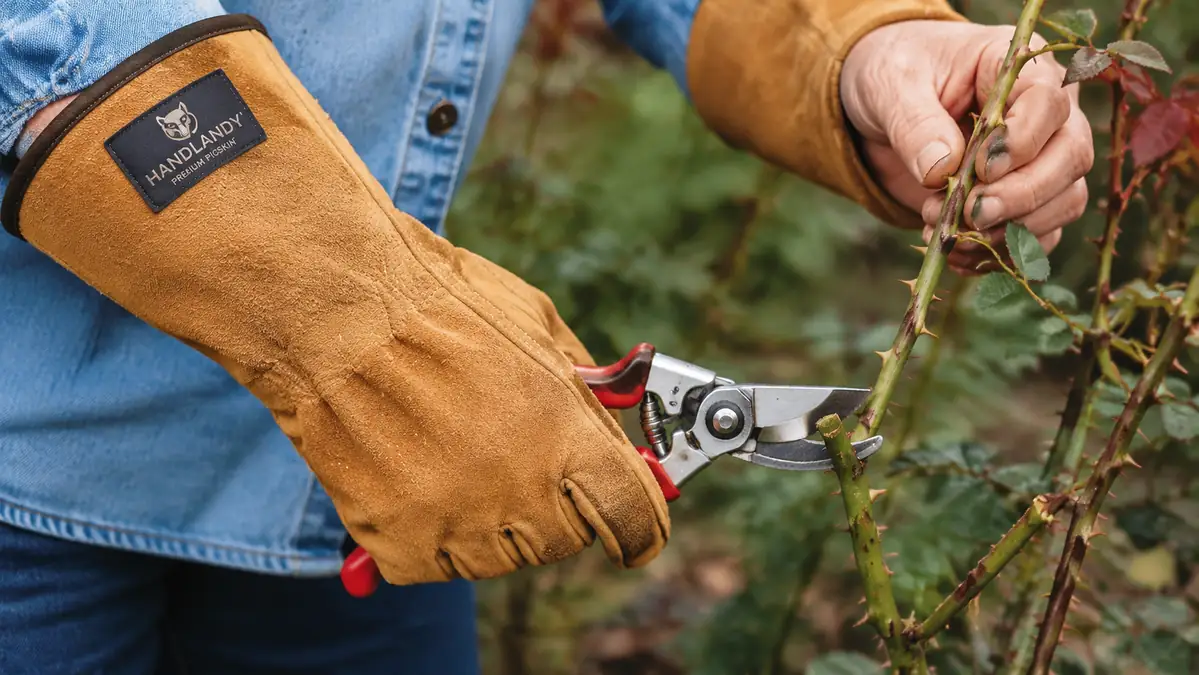
The pair I landed on is the HANDLANDY rose pruning gloves, the pigskin leather gauntlet style with the long cuff that runs most of the way up my forearm. This isn't a review written after one afternoon of light deadheading. These are the gloves that have been on my hands for a full rose season now, through the hard February pruning, spring shaping, summer deadheading, and the fall cleanup before winter dormancy, and I want to walk through exactly how the leather, the stitching, and the cuff held up under repeated, real use.
Before this pair, I'd tried two other gloves marketed as gauntlet style that turned out to be cloth with a suede palm and a thin fabric cuff, more marketing than protection. Roses don't care what the label says. A five-foot climbing cane can lay open the inside of a wrist through a flimsy suede palm in one growing season, and mine did exactly that the spring before I switched. That's the baseline everything below gets measured against, not some theoretical best case.
The Quick Verdict
A genuinely thorn-proof gauntlet glove that earned its keep through a full rose season of hard pruning and summer deadheading. The pigskin leather softened up nicely without losing its resistance to punctures, though the left thumb seam started to fray by late summer.
Amazon Check Today's Price →Tired of Walking Away From Pruning With Bloody Forearms?
The HANDLANDY gauntlet gloves cover well past the wrist in thorn-resistant pigskin leather, so climbing rose canes stop reaching your skin. Check today's price and current availability on Amazon before your next pruning session.
Amazon Check Today's Price on Amazon →How I've Used Them: A Full Rose Season, Not One Pruning Session
My rose bed runs along the back fence and around one corner of the vegetable garden, fourteen bushes total, with two climbers trained up a cedar trellis that have canes as thick as my thumb by midsummer. I started the season with the hard February cutback, taking the hybrid teas down to knee height and thinning out three seasons of dead wood on the climbers. That first session alone ran almost two hours, most of it with both arms buried elbow-deep in thorny canes trying to reach the center of the plant.
From there I was back in the gloves at least once a week through spring for shaping and disease pruning, then almost daily in June and July for deadheading, since spent blooms on hybrid teas need to come off regularly to keep new flowers coming. By the time I did the fall cleanup in November, cutting everything back ahead of the first hard frost, I'd put these gloves through somewhere around 40 separate sessions across nine months.
That's the kind of use that actually tells you something about a pair of gauntlet gloves. A single Saturday afternoon of light deadheading will tell you whether the leather feels stiff out of the box. It won't tell you whether the seams hold up after 40 sessions of gripping pruners, whether the cuff stays flexible or cracks, or whether the leather that felt a little tight on day one breaks in or just stays uncomfortable.
The Pigskin Leather and Thorn-Proof Gauntlet Design
The palm and fingers are made from pigskin leather, which is thinner and more breathable than the cowhide leather I'd worn on a pair of old work gloves years ago, but it turned out to be plenty tough against rose thorns. The gauntlet cuff extends roughly five to six inches past my wrist bone, well up the forearm, which is the actual reason I bought these over a standard pair. A climbing rose cane doesn't stop at the wrist, and neither does this cuff.
What I didn't expect was how breathable the HANDLANDY gloves stayed through a full Texas summer. The back of the hand and the underside of the gauntlet cuff use a mesh-and-leather combination rather than solid leather all the way around, so my hands weren't swimming in sweat by the second hour of a July pruning session the way they were in the all-leather work gloves I used years back.
The stitching along the palm and fingers is doubled in the high-wear spots, the pad of the thumb and the crease where the fingers meet the palm, and that doubled stitching is still intact after a full season. I did have one seam start to fray, which I'll get into further down, but it wasn't in a spot that mattered for thorn protection, and it hasn't opened up into an actual hole.
I also started conditioning the leather about halfway through the season, once I noticed the palms drying out a little after repeated exposure to hose water and morning dew on the canes. A light coat of leather conditioner worked into the palm and fingers every six to eight weeks kept the pigskin from stiffening back up, and I think it's a big part of why these still feel supple going into a second season rather than cracked and brittle the way a neglected leather glove usually ends up.
Comfort and Dexterity Through a Full Season
I wear a men's large in most work gloves, and this pair runs true to that sizing. The leather was noticeably stiff for the first two or three sessions, stiff enough that I had trouble closing my hand fully around the pruner handles without some resistance. By the fourth or fifth wearing, the pigskin had broken in and softened up considerably, and by midsummer they felt closer to a well-worn baseball glove than a new pair of work gloves.
Dexterity is the thing I was most worried about going into this, since a lot of gauntlet-style gloves trade thorn protection for stiff, clumsy fingers. That wasn't really my experience here. I can grip bypass pruners, tie off a climbing cane with garden twine, and still pick up a dropped trowel without pulling the gloves off, which is more than I could say for the cowhide work gloves I compared them against early on.
The one spot where dexterity suffers a little is fine work, things like separating tangled canes one at a time or pinching off a small side shoot by hand rather than with pruners. For that kind of detail work I still pull the gloves off, but for the bulk of a pruning session, cutting canes, hauling clippings, and reaching into the thorny center of a climber, I never once felt like I needed to take them off to get a task done.
The gauntlet cuff is the whole reason I bought these, and after a full season of climbing rose canes, it's the one feature I'd refuse to give up on any future pair.
What Held Up After a Full Season, and What Didn't
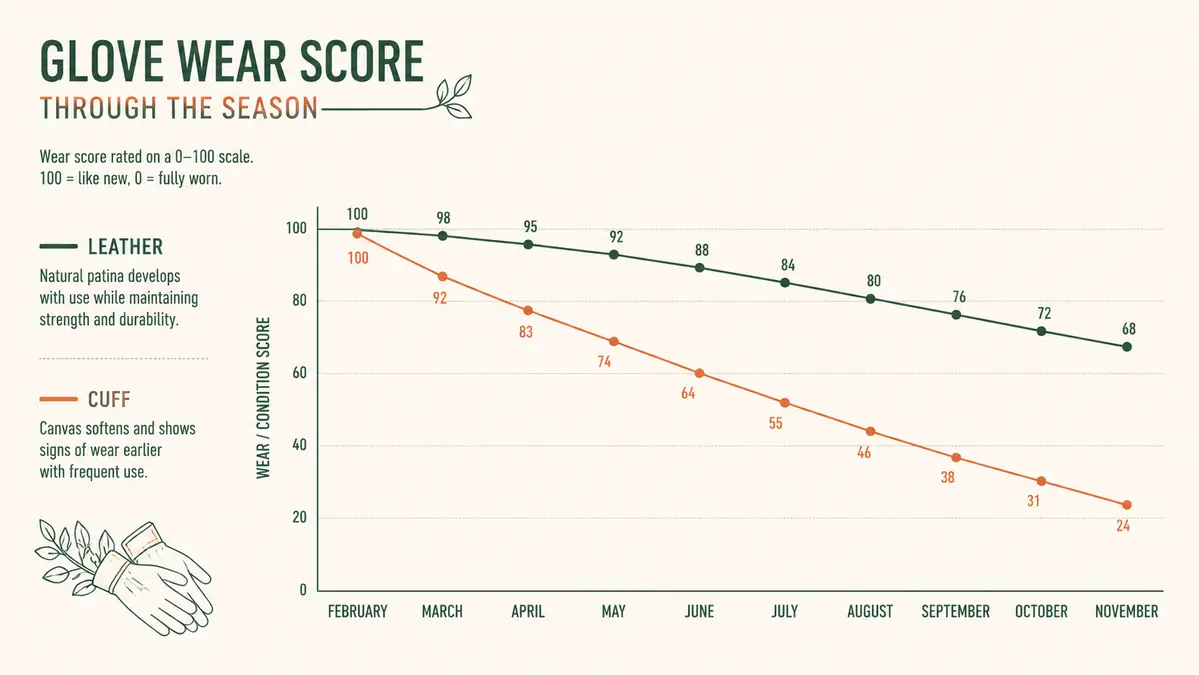
The leather itself shows the wear you'd expect from real use, a few light scuffs on the palm from gripping the metal shank of my pruners, and a slightly darker, more supple texture across the fingers where my hand flexes most. There are no punctures anywhere on the palm or fingers, which is the actual job of the glove, and after 40 sessions with thorns as long as half an inch on some of my older canes, that's the number I care about most.
What didn't hold up quite as well was the stitching at the base of the left thumb, which started to fray slightly around late August. It hasn't opened into a real hole and hasn't let a thorn through, but I've been keeping an eye on it, and if I were buying a second pair I'd expect that seam to need a touch of stitching by the end of a second full season.
The cuff elastic that keeps the gauntlet snug against my forearm is still doing its job, no sag or looseness after nine months of regular wear. I also noticed the leather held its shape well in storage. I hang mine on a hook in the garage between sessions rather than balling them up in a drawer, and I think that's part of why the leather hasn't cracked or stiffened up again the way it might if it dried out flat.
Alternatives I Considered Before Buying
Before landing on the HANDLANDY gauntlet gloves, I looked hard at a pair of rubber-coated gardening gloves with a shorter cuff, the kind most big box stores carry. They're cheaper and grip wet tools well, but the cuff barely covers the wrist, and rubber coating doesn't do much against a thorn pressed straight through the fabric backing. For light weeding they'd be fine. For roses, they weren't close to enough coverage.
I also tried on a pair of thick cowhide welding gloves a neighbor lent me, the kind meant for handling hot metal. They stopped every thorn I threw at them, no question, but they were so stiff and bulky that I couldn't feel the pruner handles well enough to make clean cuts, and my hands were sweating inside them within twenty minutes even in cooler weather. Great protection, terrible for actual garden work. They're built for a different job entirely, and it showed the moment I tried to make a precise cut close to a bud eye.
The last option I seriously considered was a cheaper synthetic gauntlet glove with a similar long cuff but a woven polyester palm instead of leather. It looked almost identical in photos and cost less, but the reviews I read described the palm wearing through within a single season of regular use. Leather costs more up front, but pigskin leather that's still puncture-free after 40 sessions is the kind of durability that actually saves money over a couple of seasons.
What I Liked
- Gauntlet cuff extends five to six inches past the wrist, real protection against long climbing rose canes
- Pigskin leather stayed puncture-free through roughly 40 pruning and deadheading sessions
- Mesh-and-leather cuff construction breathes noticeably better than an all-leather work glove in summer heat
- Leather broke in and softened after four or five wearings without losing thorn resistance
- Doubled stitching at the thumb pad and finger creases held up across a full season
Where It Falls Short
- Leather is stiff and a little clumsy for the first two or three sessions before it breaks in
- Left thumb seam started to fray by late summer, though it hasn't opened into a hole
- Not ideal for fine detail work like separating tangled canes by hand
- Runs true to size, so if you're between sizes you may want to size up for thicker hands
Who This Is For
These make the most sense if you're growing roses with real thorns, climbers, ramblers, or older hybrid tea varieties with canes thick enough to fight back, and you're doing more than a once-a-year trim. If you're pruning weekly or more through spring and summer, deadheading regularly, and doing a real cutback in late winter, the gauntlet coverage and the leather's resistance to punctures will save your forearms in a way a standard short-cuff glove just can't. It's also a solid pick if you've been scratched up enough times that you're finally ready to spend a bit more for a glove that actually does the job. I'd also point to anyone training a climber up a trellis or arbor, since that's exactly the kind of overhead, arms-deep pruning where a short-cuff glove leaves the most skin exposed.
Who Should Skip It
If your gardening is mostly weeding, planting, and light deadheading with thornless or near-thornless varieties, a lighter pair of standard gardening gloves will be more comfortable and plenty protective for what you're doing. And if you need maximum dexterity for detail work, transplanting seedlings, tying delicate stems, a thick leather gauntlet glove is going to feel like overkill on your hands. There's no version of this glove that's going to feel as nimble as a thin cloth pair, and that's a fair tradeoff for thorn protection, not a flaw. Gardeners on a tight budget who only prune once or twice a season might also be better served putting that money toward a quality pair of bypass pruners first and revisiting gloves later.
Ready to Prune Without Bracing for Thorn Scratches?
The HANDLANDY pigskin leather gauntlet gloves are available today on Amazon. Check current pricing and availability before your next pruning session.
Amazon Check Today's Price on Amazon →